
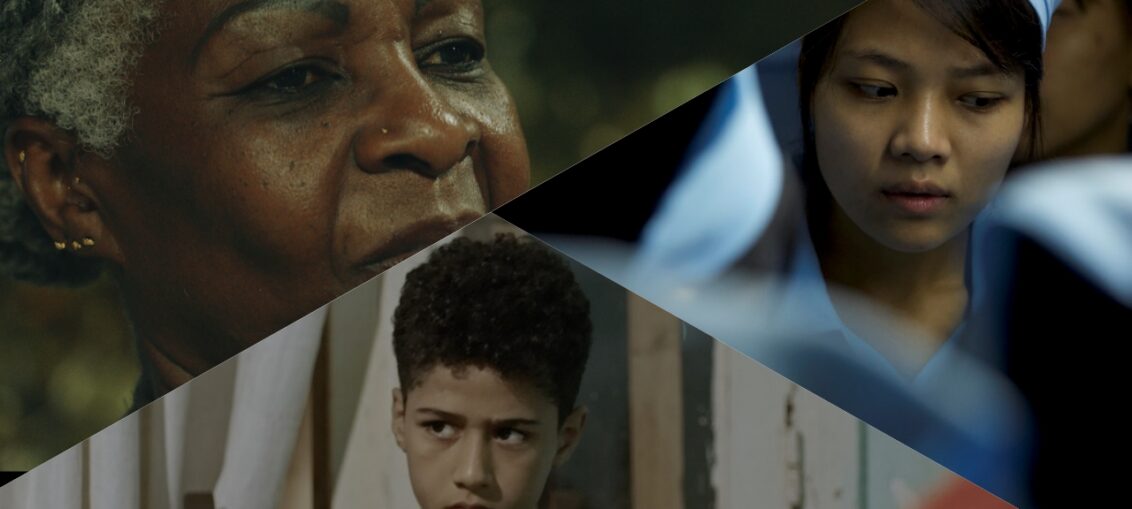
At the final jokes the festival on Asian African cinema and Latin America - from our correspondent Eleonora Ono
There are many titles seen on the exciting #mymovies platform!
Here is an overview and the impressions on the latest films scheduled on the #mymovies platform:
 #Family by Christian Carmosino
Miss, Adama, Nafissa and Irene attend the master agrinomy at the University of Ouagadougou in Burkina Faso, A professional training program on innovation and rural development in partnership with the Roma Tre University and with the support of ICS.
Have you ever seen such a dazzling smile, A face that shouts "despite everything", such a lively dance?
Everything is enclosed in this film, which tells and shows unpublished and dynamic Africa, made of tenacious daily struggle, To change and improve your life condition, In addition to that of their family, without neglecting people within the community.
Photography is full of chromatic variations and shades: The costumes have some interesting shades, which make the roller very bright, lively and engaging.
Observing the film work, you can breathe this need to renew, to make these desolate places progress. The population is very poor e, nevertheless, It enjoys humility of the little joys of life. This attitude leaves the public speechless. In any case, the desire to smile, Resilience and strength of mind makes you think.
The music that accompanies history, it is always of great hope, help and inspiration, since it rejoices and sensitizes that tiring lifestyle in which they live.
Education and poverty are two words that have never agreed. Indeed, The protagonists do not pull back and invest in their future, even if with a lot of effort.
How is it possible, that still today, in the third millennium, A part of the population of the globe is forced to live in a similar misery? So you have to think that, If you are rich or wealthy, It has grown in the "lucky" part of the world?
Reflections that arise spontaneously after similar images, Also because any human being is worthy of living in a dignified and noble place.
So, that this can be a starting point to improve!
 #ListenToTheVoices (Courtesy) Di Maxime Jean-Baptiste
The film opens the dances with a repertoire movie, in which there is a united and moved crowd to honor the memory of a young man who died suddenly, symbol of the recent history of Guyana, made of social and street violence, but also of the strength of a close -knit community
In the here and now, Melrick is a young teenager who lives in France but every summer he returns to French Guyana from his grandmother, rediscovered their roots and the musical tradition of the carnival. however, A tragic shadow weighs on the family. In a French overseas territory marked by a history of slavery and persistent violence, through a story that combines reality and fiction, The protagonist undertakes an insidious path of growth, between awareness and forgiveness.
This teaching derives from the grandmother, who in a small trip by car tells him an incident episode and Melrick follows everything with great interest, So much to understand very quickly the thread of the speech.
The boy is looking for memories, the sweet ones and the ripples, who certainly motivated this exile. The memory of that night between the 10 and 11 March 2012. “Have passed 10 years, it's as if it were yesterday”, He confides Yannick, Friend of Lucas, The murdered young man, who is persecuted by his promise of revenge. “I'm reviewing everything. Continuously”. The stain of this tragedy – and others – It looms on the Mont-Lucas residential complex.
Moreover, The connection with music will save him. The rhythm is that of the percussion of the Mayouri Tchô nèg group, where the role left vacant by Uncle Lucas assumes.
The roller oscillates between fiction and documentary, being at the same time a training story that follows the trajectory of a boy who tries to build himself through the memory of an uncle sacrificed on the altar of endemic violence that afflicts the roads, an exploration of this memory with dreamlike shades and a reflection on inherited violence – a family legacy, but also historical and colonial. "Liste to the voices" is a promising first work, with superb images that sublimate the bodies even more than the landscapes present.
The images highlight a suffering territory, but full of people who keep him alive and tell the vicissitudes.
however, The work explores more modern solutions towards trauma e, in his case, therapy sessions between the therapist and Yannick in which raw and repressed emotions are unleashed. In the case of the protagonist, The conversations between him and his grandmother offer him a perspective on the themes of revenge and the future. As a young director, Maxime is interested in the generational gap and the outlets to face our problems: traditional (singing and dance) and modern (Word therapy).
The visual language of the artistic director suggests the numerous connections between Melvick and Yannick.
In any case, It is clear a continuous journey and movement that inspires hope the right alternation of despair. It could be like this, The past of the two will always be there, But after listening to the voices, Maxime shows us a future restaurateur.
 Melvick joins the tests of a band where the community welcomes him with open arms. While the camera approaches individual tools such as trumpets and drums (Most are homemade with waste such as plastic bins and seat belts as supports), The camera frames Melvick's joyful face as he plays, to mean a profound sense of harmony. Through these performances, The poeticity in the rhythms between the image and the sound is tremendously moving.
Furthermore, The connection that is created between grandmother and nephew is the icing on the work cake, since through a voice with a calm and sweet shade, The lady manages to get to the core of the matter without too many flourishes, coming straight to the concept. A relationship of trust is established, which is not obvious.
So, The embrace between them two in front of the blue sea, makes it all romantic and poetic.
 #MaCryOfSilence in The Maw Want
“I only felt a bitter taste. In the blindness of a dark night like the pitch I asked myself: We are leaving the darkness? Or that's right that we are directed?”
This is the first fictional film that tells the current socio-political reality of Myanmar. Everything is rather disarming since, the fact of being in the third millennium, It should lead to humanity to make a greater reflection for a better future. however, It is clear that these situations are on the agenda and that, at the moment, There does not seem to be a different vision.
In any case, The dignity of man cannot be swept away in a second, due to an employer who does not respect their employees. All this is unthinkable. These facts should be told more and more, because there is no sense of guilt that can retain such testimony.
In the roller it shows how, Mi-Thet, young Burmese worker of a textile factory, He decides to join a strike, But the violent repression of the police brings to light a trauma of the past.
who, Under a ruthless supervisor, it undergoes abuse and months of non -payment. Determined to fight, adheres to a strike organized by colleague Nyein-Nyein. Indeed, The real force is dictated by the union of the workers who – slowly – they start to team up feeling even stronger, side side. Clearly this sisterhood must be lived, feel and perceive, so as not to descend to subtle moral blackmail moved by evil and petty superiors.
 The aggression by the employer against the protagonist is one of the moments of greatest energy and tension. So much so that Mi-Thet rebels against threats and does not give in to his mean blackmail. The work deserves to be paid and above all should ennoble the human being and not make it slave.
"Nobody recovers a dog that attacks his master"
In Terzio Millennio we will be able to solve this great social problem?
Photography is clear, Live and full of a pastel color palette, also going to underline the not negligible details for the battle to defend the rights at work and beyond.
 #TheSETTLEMENT at Mohamed Rashad
After the death of a man in a fatal accident at work, The only compensation offered to the family is the possibility for his two children, Hossam (23) and maro (12), to be used in the same factory, side by side with the man responsible for the death of his father.
The film flows rather slowly: it is usually not a disadvantage but, in this case, This calm tends to flatten the story a little too much, making the Plot Twist static and apathetic.
Anyway, reflection is looking at, and the injustices come to the surface.
The truth of the dynamics of the death of the father of the two boys remains a mystery veiledly, Perhaps a piece that unites various points of the plot is missing, getting lost in the non -verbal communication of the "unspoken".
How much the mind of the human being can be manipulated? In this case Hossam has been clearly stuck and there is no one who exposes himself to save him, as well as the younger brother.
Then reflection arises spontaneously: nobody saves himself alone, But if - also - the trusted people take back in a moment of extreme difficulty, As you can believe in the other?
Values such as friendship, solidarity, Loyalty should be part of the newspaper.
 In this case, Fortunately, the brotherhood was extremely necessary to save more than one life.
From the point of view of the artistic direction, Photography is not very saturated, clear, and with little contrast.
The chromatic selection belongs to calm colors as if the director had not wanted to tread his hand on the colors, otherwise the attention would have moved elsewhere.
Eleonora Ono